
How to Get a Driving Licence in Cyprus: Complete 2026 Guide
 27 June 2026 · Matthieu Tissot
To get a Cyprus driving licence, you need to complete four steps: apply for a learner's licence at the Department of Road Transport, complete lessons with a licensed instructor, pass the theory test, and pass the practical test. The process typically takes three to six months for a new driver. EU citizens can exchange their existing licence without sitting tests; other nationalities should check their status with the Department.

Getting a driving licence in Cyprus is very doable, but the system has a few quirks that catch people off guard. Whether you are a young Cypriot sitting your first test or a newcomer arriving with a licence from another country, the rules are not always obvious. This guide pulls together everything you need to know for 2026, based on how the process actually works in practice.
How does the Cyprus driving licence system work?
The Department of Road Transport - in Greek, Τμήμα Οδικών Μεταφορών - is the only body that can issue a driving licence in the Republic of Cyprus. It sits under the Ministry of Transport, Communications and Works. The headquarters is in Nicosia, with offices in Limassol, Larnaca, Paphos, and Paralimni. You will deal with one of these offices at every stage of the process.
Cyprus follows EU driving licence standards. That means the licence categories, the card format, and the rights that come with each category all align with what you see across Europe. A licence issued here is valid in every EU member state. That is a solid benefit if you travel or move around Europe.
One thing that surprises newcomers: Cyprus drives on the left. The island kept left-hand traffic from its time as a British territory. Road signs show distances in kilometres and speeds in km/h, so the mix of left-side driving and metric measurements can feel odd at first if you are from the UK.
The Republic of Cyprus covers the southern part of the island. The north operates under a separate system. A Cypriot licence issued by the Department of Road Transport does not automatically apply in Northern Cyprus. This article only covers the Republic.
For a broad starting point, the ClickClickDrive Cyprus platform has useful tools and school listings to help you plan ahead.
Who can apply and what is the minimum age?
The minimum age for a Category B licence - the standard car licence - is 18. You cannot sit behind the wheel as a learner before that birthday, and you cannot take either test until you meet the age requirement.
Beyond age, the Department looks at two other things: identity and residency. You need to be legally resident in the Republic of Cyprus to apply here. You cannot, for example, be based in another EU country and come to Cyprus just to take the test.
Residency is proved by documents. The Department accepts a rental contract, a utility bill in your name, or your yellow slip (also called the ARC - Alien Registration Certificate). If you hold a yellow slip, bring it. It is the clearest proof of legal residence.
Your identity document must be valid. A passport or national ID card both work. If your document is expired, sort that out first. The Department will not process an application with an out-of-date ID.
There is no upper age limit for applying for a first licence. However, once you hold a Category B licence and you reach 70, renewal involves medical checks. For other categories the rules may differ, so check directly with the Department.
Anyone planning to go through the full process from scratch will find our step-by-step driving licence guide useful alongside this one.
How do you get a learner's licence?
The learner's licence - εκπαιδευτική άδεια in Greek - is your legal permission to practise driving on public roads. Without it, you cannot take a single lesson in a real car on a real road.
You apply for it in person at any Department of Road Transport office. Bring the following:
- Valid passport or national ID card
- Proof of residence (rental contract, utility bill, or yellow slip / ARC)
- A recent passport-style photograph
- A medical certificate from a registered doctor confirming you are fit to drive
The medical certificate is a step people often forget. Any registered doctor in Cyprus can issue it. It confirms you have no medical condition that would prevent safe driving. Get this done before you go to the Department, or your application will stall.
Fees are set by the Department and can change. Do not rely on figures printed in older guides or forum posts. Check the current fee directly with the Department of Road Transport before your visit.
Once your learner's licence is approved, you are in the system. You can book lessons, and when the car is moving with you at the wheel, red L plates must be displayed on the front and rear of the vehicle at all times. This is a legal requirement, not a suggestion.
Confirm your exact path with the Department of Road Transport.
What should you expect from driving lessons?
Lessons in Cyprus must be taken in a dual-control car with a licensed instructor. The dual-control setup means the instructor has their own set of pedals. This is standard safety practice and a legal requirement for the teaching vehicle.
Each lesson typically lasts 45 minutes. The number of lessons you need depends entirely on your starting level. Someone who has driven abroad for years will need fewer sessions than a complete beginner. Most instructors are honest about this. They want you to pass, not to sell you extra hours you do not need.
Prices vary between schools and between cities. It is normal and sensible to shop around. Our guide to driving lesson costs in Cyprus breaks down what people are actually paying across different areas. If you are based in the capital, the list of driving schools in Nicosia is a good place to compare options.
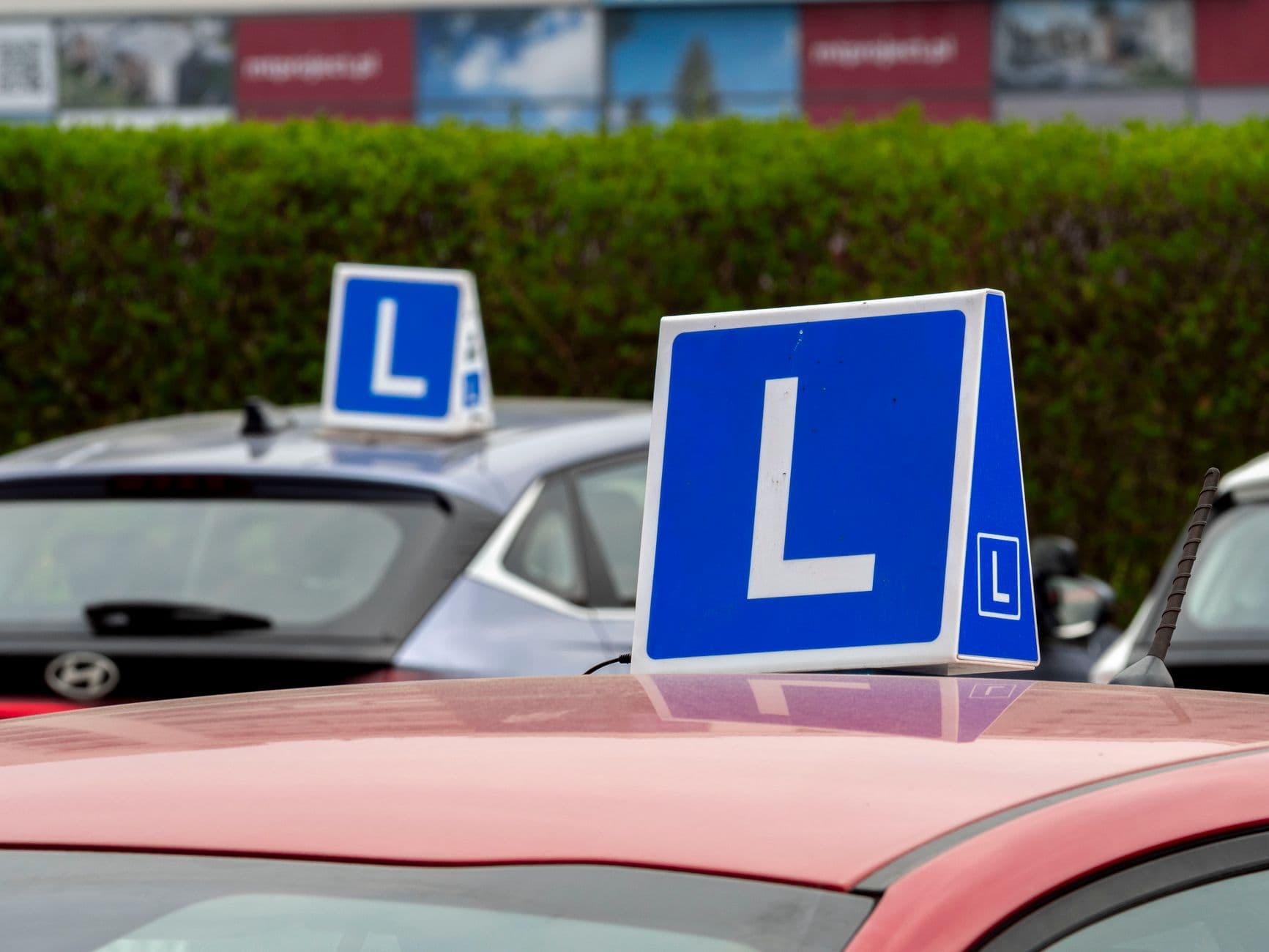
Lessons cover more than just basic car control. Instructors will take you through roundabouts, which are very common on Cypriot roads. They will work on hill starts, parking, and how to handle the mix of urban and rural roads you will encounter in the practical test. Cyprus roads can be narrow in older town centres, so urban manoeuvring gets real attention.
Your instructor will tell you when they think you are ready for the theory test and then the practical. Take that advice seriously. Sitting the tests before you are ready costs time and money.
Driving Licence Cost Calculator
Estimates only. Current fees are set by the Department of Road Transport and may change.
What does the theory test cover and how do you pass?
The theory test is computer-based. You sit at a screen and answer multiple-choice questions. The good news for non-Greek speakers: the test is available in both Greek and English. You choose your language when booking.
The questions draw from three main areas: road signs and their meanings, traffic rules, and safe driving behaviour. Some questions use images of road scenarios and ask what you should do. Others are straightforward knowledge checks on signs or speed rules.
The Department of Road Transport provides official study materials. Your driving school will also have practice question banks. Use both. The question formats are consistent, so practising with real sample questions is the most effective preparation method.

Book your theory test through your Department of Road Transport office. There is a fee for each attempt, so it is worth being well prepared before you sit. If you fail, you can rebook, but each attempt costs money and adds time to the overall process.
People who pass tend to have done one simple thing: they worked through as many practice questions as possible before the test day. Passive reading of the highway code is less effective than active practice. Treat it like a real exam and revise accordingly.
Once you pass the theory test, you are cleared to book the practical.
What happens on the day of your practical test?
The practical test takes place on real public roads. You will not be in a closed car park or a test circuit. An examiner from the Department of Road Transport sits in the passenger seat and assesses your driving in live traffic conditions.
The examiner will give you directions and watch how you handle the vehicle, the road, and other road users. They check things like observation at junctions, use of mirrors, correct lane positioning, and how you deal with other drivers, cyclists, and pedestrians. Speed matters too. Driving too slowly can be marked against you, just like driving too fast.
The test vehicle is your driving school car. Your instructor will normally bring the car to the test centre, but they do not accompany you during the test itself. It is just you and the examiner.
Nerves are normal. Examiners in Cyprus are professional and clear in their instructions. If you do not understand a direction, you can ask them to repeat it. Do not guess and turn the wrong way.
If you pass, the examiner confirms it at the end. You then collect your licence from the Department. If you do not pass, the examiner will explain the reasons. You can rebook and try again. There is no limit on the number of attempts, but each one carries a fee, and you may need more lessons in the areas where you struggled.
What are the licence categories, validity, and renewal rules?
Cyprus uses the EU category system. Here is a quick breakdown of the main categories:
- AM - mopeds and light quadricycles
- A1 - small motorcycles (restricted power output)
- A2 - mid-range motorcycles (restricted power output)
- A - full motorcycle licence, all power outputs
- B - passenger cars up to 3,500 kg and carrying no more than 8 passengers (this is what most people are after)
- C - trucks and heavy goods vehicles
- D - buses and passenger-carrying vehicles
- BE / CE / DE - trailer combinations added to the matching base category
Category B is by far the most common. It is what you get from the standard car test and it covers the vast majority of vehicles people drive day to day.
A Category B licence issued in Cyprus is valid across all EU member states. You can drive in Greece, France, Germany, or any other EU country without any extra paperwork. That mutual recognition is one of the real practical benefits of holding a Cypriot licence.
On validity: a Category B licence is typically valid until you reach age 70. After that, renewal requires medical checks. The exact rules and renewal intervals can change, so verify current requirements with the Department of Road Transport rather than relying on old information.
Fees for licence applications and renewals are set by the Department. Always check current amounts directly with them before applying.
What if you already hold a foreign driving licence?
This depends entirely on where your licence was issued. The rules differ for three groups of people.
EU and EEA citizens living in Cyprus can keep using their home country licence for as long as they live here. However, there is a window after taking up residence during which you can exchange your foreign licence for a Cypriot one without sitting any new tests. The exchange is administrative - no theory test, no practical. The exact window period can change, so check the current timeframe with the Department of Road Transport. Our guide on exchanging an EU licence covers the exchange process in detail.
UK licence holders are in a different position after Brexit. The UK is now treated as a third country for exchange purposes, not as an EU state. This means a certified translation of your licence may be required, and depending on the current bilateral agreement between Cyprus and the UK, you may need to sit one or both tests. The situation can change as agreements are updated. Read the full breakdown in our guide on UK licences in Cyprus after Brexit and then confirm the current position with the Department before you do anything.
Third-country nationals - people from countries not on the Department's recognised exchange list - typically go through the full new-driver process. That means applying for a learner's licence, completing lessons, passing the theory test, and passing the practical. Our guide for foreigners in Cyprus explains this path in more detail and covers what to expect at each stage.
Whatever your nationality, the first call should always be to the Department of Road Transport. The rules are updated periodically, and only the Department can give you a definitive answer about your specific situation.
Getting a driving licence in Cyprus takes planning, but it is a straightforward process once you know what to expect. The Department of Road Transport offices are your main point of contact from the first application to the final card. Start with your documents, find a good instructor, take the tests when you are ready, and the licence will follow. For most people, three to six months is enough time to go from zero to licensed driver.
About the Author

Co-Founder, ClickClickDrive
Matthieu is Co-Founder and CMO of ClickClickDrive, a marketplace that makes finding the right driving school effortless for learners across Europe. He built the platform from zero to over 2.5 million monthly organic visitors, reaching 30% B2C market share in Germany.
FAQ
How long does it take to get a driving licence in Cyprus?
Most new drivers complete the process in three to six months. The timeline depends on how quickly you book lessons, how many you need, and when test slots are available. Demand for test slots can be high in busy periods, so book as soon as your instructor says you are ready.
Can I take the theory test in English in Cyprus?
Yes. The computer-based theory test is available in both Greek and English. You choose your preferred language when you book your test at the Department of Road Transport. Study materials are also available in English.
Do I need a medical certificate to apply for a learner's licence?
Yes. You need a medical certificate from a registered doctor in Cyprus confirming you are fit to drive. Any registered doctor can issue this. Get it before your appointment at the Department or your application cannot proceed.
What documents do I need to exchange a foreign driving licence in Cyprus?
The exact documents depend on your nationality and which country issued your licence. At a minimum, expect to bring your valid foreign licence, a valid passport or ID, proof of residence in Cyprus, and a passport-style photograph. A certified translation may also be required. Always confirm the full list with the Department of Road Transport before your visit.
Is a Cyprus driving licence valid in other EU countries?
Yes. A Category B licence issued by the Republic of Cyprus is valid across all EU member states. You can drive in any EU country using your Cypriot licence without any additional permits or paperwork.